 Handstand Pro
Balance · No wall
Split handstand
The handstand without a wall, one leg forward and one back, like scissors. Your center of gravity sits lower than with your feet together, which makes it the best place to learn freestanding balance.
Not to be confused with the straddle, legs wide to the sides.
- Family
- Balance
- Equipment
- Open floor space
- Type
- Hold
Train this exercise in the app
How to do it
- Stand in a lunge, raise your arms and place your hands on the floor in front of you.
- Kick your back leg up, without trying to bring your feet together.
- Lock your legs in a scissor, one forward, one back.
- Find the point where your hips are over your hands, and hold it with your fingers.
- When you go past vertical, cartwheel out.
Two mistakes to avoid
Letting fear set the kick. A well-dosed kick-up only comes from getting it wrong both ways: too hard one time, too soft the next. If you always drop back the same way, fear is often holding the kick back, and the cartwheel bail is what fixes that.
A wandering gaze. Your head tucking between your arms, or reaching for the floor, shifts your balance every time. Pick a spot at the base of your hands and stay on it.
A coach in your ear
Upside down, you can't read a screen. In the app, a voice guides you through the exercise and tells you what to fix right when you need it. For example, when your back starts to arch:
“Tilt your pelvis backward”
Train this exerciseRelated exercises
 Full hold (feet together)The handstand as you picture it: legs together from start to finish, body stacked from hands to feet.
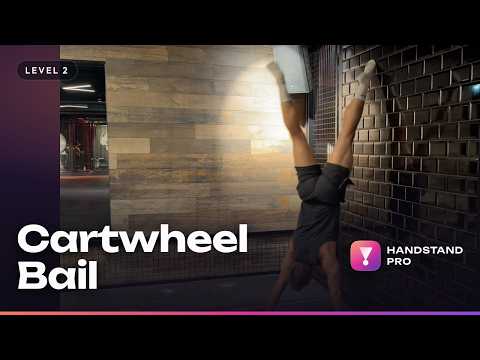 Cartwheel bailThe exit you'll use on every freestanding attempt: a hand to the side, the hips turn.
 Toe pullsFacing the wall, you lift your toes off by pressing into your fingers: your first real balance.
All exercises: the catalog